Cabling & connectivity

Structured cabling and connectivity, the layer every network sits on

Copper and fibre cable, patch panels, keystone jacks, faceplates and patch cords, with products from 3M, Leviton, Schneider Electric and Vivanco.

Overview

What is structured cabling?

A standardised way of wiring a building for data: permanent cable runs from outlets to patch panels, organised and labelled so devices can be moved or added by re-patching instead of re-cabling.

ZOMSOL supplies the components that make up that system, from manufacturers including 3M, Leviton, Schneider Electric and Vivanco. Because ZOMSOL also supplies the switches that connect to it, the cabling and the active equipment can be specified to match.

Technician connecting network cables at a patch panel
Termination at the patch panel

Why it matters

Cabling is the part you replace least, so it's the part to get right

A cabling installation normally outlasts several generations of switches and access points.

It outlives the equipment

Choosing a category for tomorrow's speeds avoids pulling new cable when the next switch or access point arrives.

It limits every device on it

A 10G switch on cable rated for Gigabit delivers Gigabit. Poor terminations cause intermittent faults that look like equipment problems.

It is the hardest to change

Once cable is behind walls, ceilings and trunking, changing it disrupts the whole building. Planning outlets and routes early costs far less.

Components

What ZOMSOL supplies for the physical layer

Confirm specific products, lengths and quantities when you enquire. Availability varies by manufacturer and specification.

01

Copper network cable

Twisted-pair cable for horizontal runs from outlets back to the patch panel.

Cat6Cat6AUTPShielded
02

Fibre optic cable

For backbone links between floors, buildings and cabinets, and for runs beyond copper's 100 m limit.

MultimodeSingle-mode
03

Patch panels

The termination point for permanent runs, keeping the cabinet tidy and changes simple.

24-port48-portKeystone
04

Keystone jacks

RJ45 modules for outlets and modular panels, matched to the cable category.

RJ45Cat6Cat6A
05

Faceplates & outlets

Wall and desk outlets where users and devices plug in.

SingleDualLabelled
06

Patch cords

Cords from panel to switch and from outlet to device, in the same category as the permanent link.

CopperFibre

Brands for this category: 3M, Leviton, Schneider Electric and Vivanco. See the full brand list

Cable categories

Cat6, Cat6A or fibre?

Most new business installations use Cat6 or Cat6A for horizontal runs and fibre for backbone links. Here is where each fits.

MediumSpeed and distanceWhere it fits
Cat61 Gbps to 100 m; 10 Gbps up to about 55 m. Rated to 250 MHz.General office outlets, cameras and phones
Cat6A10 Gbps to the full 100 m. Rated to 500 MHz.Wi-Fi 6/6E access points, busy areas, long-life installations
Multimode fibre (OM3 / OM4)10 Gbps to roughly 300 m (OM3) or 400 m (OM4)Backbone links inside a building or campus
Single-mode fibre (OS2)10 Gbps over many kilometresLinks between buildings and long runs

Copper Ethernet channels are limited to 100 m in total: typically up to 90 m of permanent cable plus up to 10 m of patch cords.

Planning checklist

Five things to settle before cable goes in

Useful whether you're fitting out a new office or extending an existing network.

Glowing ends of fibre optic strands
01

Count outlets, not just desks

Include cameras, access points, printers, phones and displays. Adding an outlet during installation is far cheaper than adding it afterwards.

02

Measure the longest runs

Any run approaching 90 m of permanent cable needs a closer cabinet or a fibre link instead.

03

Pick the category for the next ten years

If Wi-Fi 6 access points or 10G links are likely, Cat6A avoids re-cabling later.

04

Match every component to the category

Cable, jacks, panels and patch cords all need the same rating, or the link performs at the lowest one.

05

Label everything

A consistent scheme at the outlet and the panel turns future moves and fault-finding into minutes instead of hours.

FAQ

Structured cabling questions

Have a different question? Ask ZOMSOL

Should I use Cat6 or Cat6A?

Cat6 carries Gigabit to 100 m and suits most office outlets. Cat6A carries 10 Gbps to 100 m, so it is the better choice where Wi-Fi 6/6E access points, 10G links or a long installation life are expected.

When do I need fibre instead of copper?

When a link is longer than copper Ethernet's 100 m limit, when it runs between buildings, or when you need high-capacity backbone links between network cabinets.

Which cabling brands does ZOMSOL supply?

Cabling and connectivity products from 3M, Leviton, Schneider Electric and Vivanco. Please confirm the specific product and specification when you enquire.

Can ZOMSOL supply cabling and switches together?

Yes. ZOMSOL supplies both structured cabling components and networking equipment, which makes it easier to keep cable category, port speeds and uplinks consistent.

Planning new cabling or an extension?

Share the number of outlets, rough run lengths and the speeds you need. We will help you choose matching cable, connectivity and switching.
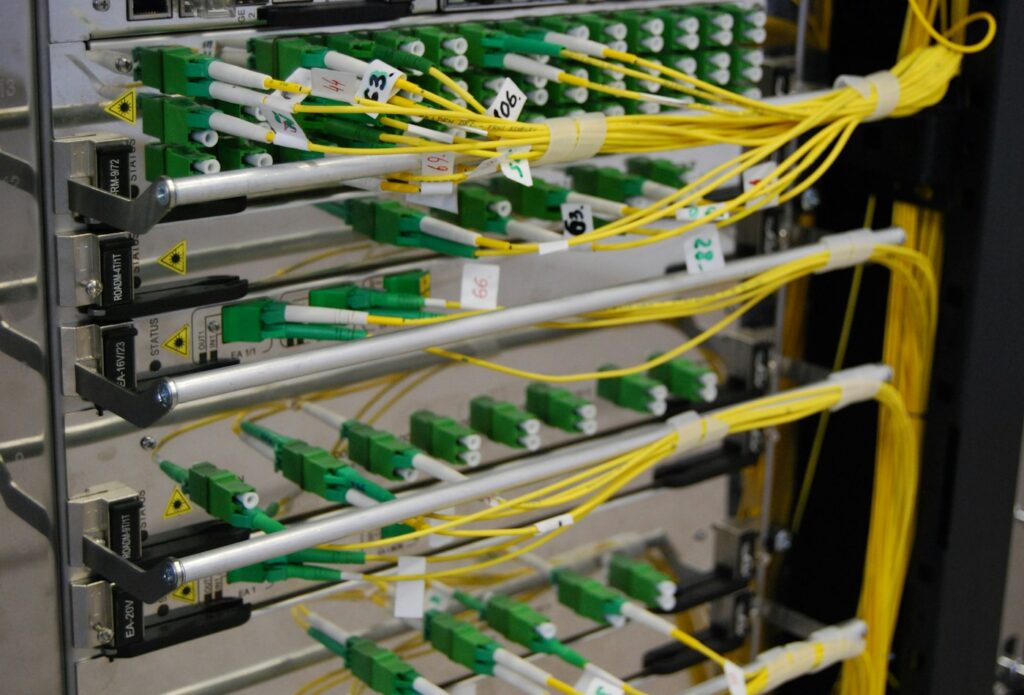
Yellow fibre optic patch cords connected in a network rack
Scroll to Top